Formalisms
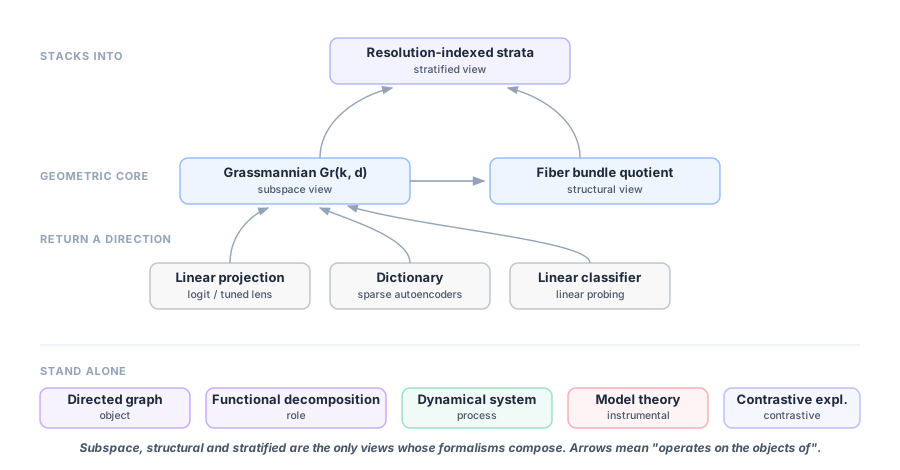
Section titled “Formalisms”Formalisms are mathematical languages for expressing mechanistic claims. They are not in a one-to-one relationship with views — a single view can be expressed through multiple competing formalisms, and a single formalism can serve multiple views. The subspace view, for example, can use Grassmannian geometry for linear subspaces or Riemannian geometry for nonlinear manifolds. Whitney stratification serves the stratified view but also describes the internal structure of the Grassmannian itself.
How formalisms compose
Section titled “How formalisms compose”The mathematics stacks in one corner of the framework and nowhere else. Three method-level tools each return a direction; a direction is a point on the Grassmannian; the Grassmannian carries the fiber bundle; and strata are indexed over both. So the subspace, structural and stratified views share machinery, and the remaining five formalisms depend on nothing and carry nothing.
View-associated formalisms
Section titled “View-associated formalisms”Each formalism is listed with its primary view association, but most can serve multiple views:
- Model Theory — primarily the instrumental view; predictive equivalence
- Measurement Algebra — primarily the perspectival view; measurement operations as objects
- Directed Graph — primarily the object view; circuit graphs
- Functional Decomposition — primarily the role view; roles and their dependencies, loose by necessity since a role is multiply realizable
- Grassmannian — primarily the subspace view; also used by the structural and stratified views for linear strata
- Fiber Bundle — primarily the structural view; gauge orbits, holonomy
- Dynamical System — primarily the process view; training dynamics
- Resolution-Indexed Strata — primarily the stratified view; Whitney stratification is the mathematical antecedent, and no operational claim depends on its regularity conditions
Method-level formalisms
Section titled “Method-level formalisms”These are not tied to a single view but are used by specific interpretability methods:
- Causal Graph — used by causal scrubbing and causal abstraction
- Linear Classifier — used by linear probing
- Dictionary — used by sparse autoencoders (SAEs)
- Linear Projection — used by logit lens and tuned lens